Apartment balconies in Australia offer two things in equal measure: a view out, and a view in.
The view out iswhy you wanted the balcony. The view in is the problem, with neighbouring units at the same level, higher-floor sightlines from the building across the street, and a creeping feeling that there's no real separation between your outdoor space and the world beyond the railing.
For most of us, the instinct is to build something — a screen, a frame, or a partition of some sort. But permanent structural additions to a balcony may require body corporate approval, and your scheme may be reluctant to grant it, particularly if it changes the external appearance of the building.
Luckily, there is a solution that doesn’t require a single wall or permanent fixing, and that’s artificial greenery. Below, we’ll go over 6 approaches we recommend, from the fastest one-piece solution to the most complete transformation.
Key Takeaway
Always choose the type of artificial greenery according to the material of the wall or fence and the overall space available. In a nutshell, here’s what you should do for each:
-
Glass railing with no floor space: tall potted grasses or a freestanding hedge planter placed directly behind the railing
-
Narrow balcony with limited floor space: trellis panels attached to the railing with cable ties, or hanging garlands from an overhead beam
-
Corner balcony needing enclosure on two sides: 2 freestanding hedge planters positioned at the corner, or spike topiaries in a planter bed
-
Full-perimeter privacy: a combination of panel runs on the railing with freestanding specimens at key sightline points
6 Best Artificial Plants for Balcony Privacy
Each of the 6 options below solves a specific version of the same problem. The right choice depends on your railing type, your floor space, your strata by-laws, and how much of the perimeter needs addressing.
Here’s your starting point.
1. Tall potted grasses and statement plants
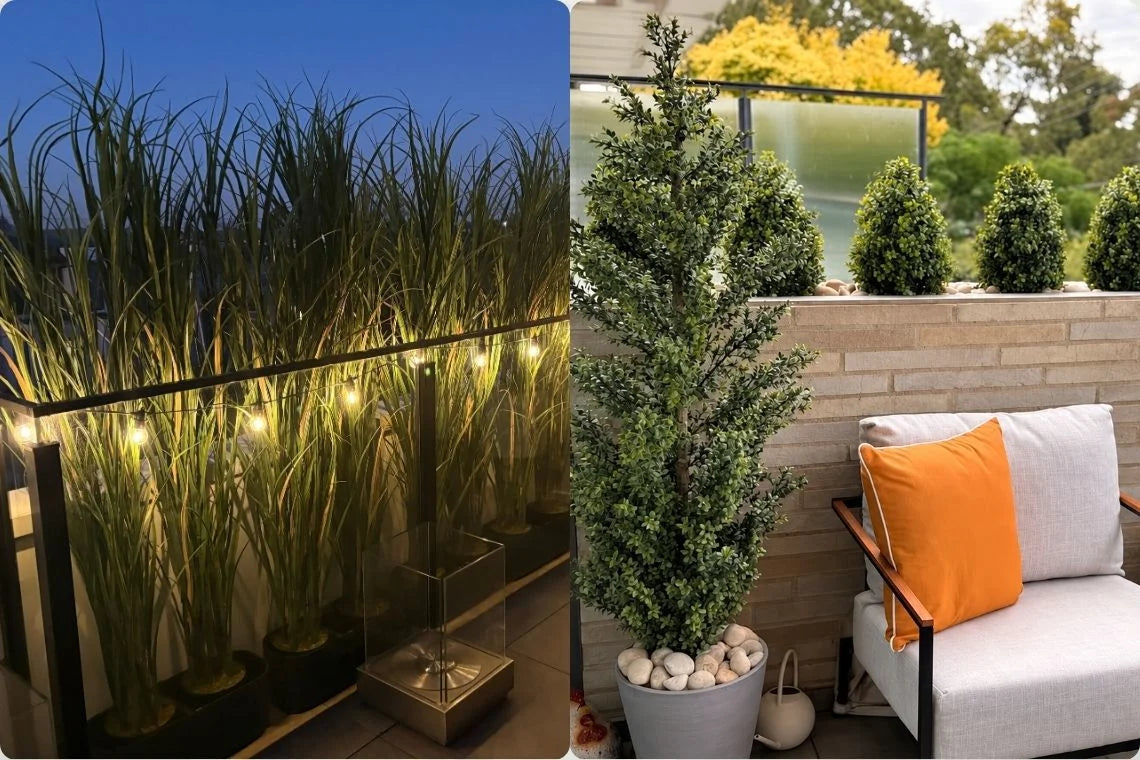
The fastest route to balcony screening with no fixings is to get a cluster of tall artificial potted grass placed directly behind a glass or metal railing. Ideally, it would reach above railing height and break sightlines without any attachment to the building structure.

That’s what a recent client of ours did using the 150cm Artificial Snake Plant. She lined multiple tall plants in individual pots, lit from below with warm Edison string lights. Notice two things worth taking from this installation: the uniform height creates a consistent screen, and the lighting transforms the space entirely after dark.

For Australian balconies, only UV-rated artificial products belong outdoors. Our UV-resistant outdoor artificial plants range includes ornamental grasses, potted bamboo, yucca, and tall specimens rated for full outdoor exposure, and it’s the only category we recommend for any balcony application receiving direct or indirect sun.

For a full breakdown of which heights and species work best for balcony sightline screening, our guide to choosing the right outdoor artificial plant covers the specific considerations for elevated balcony environments.
2. Freestanding hedge planters
A freestanding hedge planter combines dense boxwood foliage and a weighted base in a single self-contained unit. These products don’t need a wall to hang on and don’t need to be attached to the railing. In fact, all you need to do is place it, position it, and done.
The key specification detail for balcony use is this: confirm the unit is weighted for wind stability at your floor level. High-rise balconies experience significantly stronger wind loads than ground level, and a lightweight unit that performs on a second-floor terrace may not on a tenth-floor balcony. Our freestanding hedge planters range shows the full size range with specifications, but we always recommend adding weighted material inside to keep it secure.
This approach works great when you use 2 freestanding hedge planters at the corners of a glass-railed balcony to create an enclosure without a single attachment.
3. Artificial green wall panel runs on the railing
For balconies where the railing itself is the problem (like a glass or wire balustrade that offers no visual barrier), attaching artificial green wall panels or boxwood hedge panels directly to the railing face is the most coverage-per-metre option available.
Hedge coverings for walls and fences are a low-cost, easy, and effective way to protect your privacy because they turn functional outdoor surfaces into beautiful ones without the maintenance of natural alternatives. For balcony railings, panels attach with UV-rated cable ties through the panel grid, looped around the railing bars, so you won’t need screws or drilling.
Our boxwood hedge panel range and vertical garden panels both work for railing attachment. There is a slight distinction, though: boxwood panels create a formal, structured privacy screen, while mixed botanical panels create a more naturalistic botanical surface.
The choice depends on the aesthetic of the space and the density of screening required. For long railing runs, this is the most efficient single-piece coverage solution we offer.
4. Artificial trellis panels
Where a railing or fence face needs a lighter, more architectural treatment (or where an existing fence already provides some privacy but needs softening), our expandable ivy trellis range offers a different visual register from the denser panel options.
Trellis panels are particularly effective on balconies where full panel density would feel too enclosed. If you want your greenery to filter light and sightlines rather than block them completely, the trellis might be the best option for you.
Similarly, for a balcony that already has a semi-private railing and needs character more than complete screening, a trellis is often the right call. The expandable format means they fit across variable railing widths without trimming.
5. Artificial topiary in pots and spike topiaries
Topiary brings a different quality to balcony privacy than hedge panels or grasses. This is so because topiary is architectural rather than naturalistic, and it works particularly well on balconies where the brief is a formal aesthetic first, and privacy second.


Cone and ball topiaries in coordinated planters placed at intervals along a railing or at balcony corners create structured vertical presence without the density of a full panel run.


For balconies with existing planter beds or soil substrate, spike topiaries push directly into the growing medium with no separate pot required. A recent client of ours shows exactly how this works in a long, narrow planter: uniform cone topiaries on spikes, river pebbles between each base, and a structured border as the result.

6. Artificial hanging plants and ceiling garlands
If your balcony has an overhead structure like a pergola beam, a ceiling, a cantilevered element, or even a strong overhead rail, don’t look further than artificial hanging plants. They address the overhead sightline problem: the view in from above, or the sense of exposure that a glass or open-top balcony creates.
A run of hanging garlands from an overhead beam at consistent drop lengths creates a green canopy that encloses the space from above. The UV-resistant hanging plants range includes dense fern baskets, trailing ivy, and mixed botanical garlands at drops from 55cm to 260cm.
For attaching hanging plants where there's no obvious overhead hook, our guide on how to attach hanging plants to different surfaces covers ceiling hooks, beam clamps, curtain rail mounts, and tension wire systems. As our hanging plants balcony project shows, the overhead plane is consistently the most underused privacy and styling tool on apartment balconies, so it’s about time you took the leap.
Considerations Before You Choose an Artificial Plant
-
UV rating is non-negotiable. Every product mentioned in this guide needs to carry UV certification for outdoor use. At Designer Plants, we use UVTex inhibitors integrated within the leaf to ensure that the products don’t degrade in the sun. We even have warranties to protect you from premature fading and other issues.
-
Check your by-laws beforehand. Cable ties and removable fixings are generally considered non-permanent and are widely accepted in strata schemes, but by-laws vary. If your scheme requires approval for any railing attachment, get it before installation day.
-
Wind load increases with height. A product that performs on a second-floor balcony may not be stable on a fifteenth-floor one. For high-rise balconies, confirm the weight and base stability of freestanding units, and use additional weight and cable tie points for panel runs.
-
Think about the view from inside. The balcony privacy solution that looks best from inside the apartment is almost always a consistent height along the railing. That means uniform hedge planters, a panel run, or a plant cluster at the same height across.
Finishing Thoughts
A balcony without privacy isn't a usable outdoor space. It’s basically a room without a door.
The good news is that the fix rarely requires anything structural, anything permanent, or anything the body corporate needs to approve. The right artificial greenery, correctly sized for your railing height and your specific sightline problem, turns an exposed balcony into somewhere you can’t wait to spend time.
We've helped thousands of Australian apartment owners solve this problem in strata schemes, in high-rises, on narrow terraces, and on ground-floor courtyards. The consultation is free, and the recommendation we give is specific to your space.
Stop by our showroom in Braeside, VIC, or book a free consultation with our team so we can give you bespoke advice on your space.
FAQs
-
What is the best artificial plant for balcony privacy in Australia?
-
It depends on your railing type and floor space. For glass railings with good floor depth, tall ornamental grasses or a freestanding hedge planter are the most effective. For narrow balconies, a boxwood hedge panel attached to the railing with cable ties gives the most coverage per square metre. All outdoor balcony plants must be UV-rated with integrated UVTex inhibitors to ensure they don’t fade outside.
-
Can I attach artificial panels to a strata balcony railing without approval?
-
In most strata schemes, cable tie attachment is considered non-permanent and doesn't require body corporate approval. However, by-laws vary by scheme. We recommend checking your specific by-laws before attaching anything to the railing, particularly if the panels are visible from the street or common areas.
-
Do artificial plants create enough privacy on a balcony?
-
Yes, when the right product is correctly sized and positioned. A consistent height run along the railing, or a dense freestanding hedge planter at sightline-specific positions, blocks views effectively. The detail that’s very easy to miss is consistency of height: a uniform boundary at railing height provides privacy, but a varied-height planting may leave visible gaps.
-
What is the best option for a balcony with a glass railing?
-
Freestanding hedge planters or tall potted grass products placed directly behind the glass are the most effective because they rise above the railing and break sightlines without attaching to the glass structure. For a more comprehensive solution, panel runs cable-tied to the base of the glass frame combined with taller products at the corners creates full perimeter coverage.
-
How do I create privacy on a high-rise balcony?
-
The same options apply at high-rise, but wind stability is the additional constraint. Choose freestanding units with weighted bases, use more cable tie attachment points for panel runs, and avoid lightweight hanging elements in exposed conditions. Confirm product wind-resistance ratings with our team for any balcony above the fifth floor.