
A hotel lobby has approximately 30 seconds to communicate everything a guest needs to know about your property.
Your lobby has half a minute to make the difference between “this is somewhere special” or “this will do” before the front desk interaction, before the key card handover, and before anyone has seen the room.
It all happens in the lobby, the moment a guest walks through the door.
If you’re a hotel operator and hospitality designer, you already know that the lobby is the most commercially critical piece of real estate in the building. And yet it’s also the space most likely to accumulate a series of design decisions that, while individually defensible, are collectively damaging.
We’ve worked with Mercure Hotel, the Accor Group, and commercial hospitality clients across the country (and worldwide) for over 20 years.
There are 6 mistakes we see consistently across hotel lobbies, and the tips to fix them with architect-preferred, designer-specified artificial greenery installations.
6 Common Mistakes to Fix in a Hotel Lobby
Whenever you notice something isn’t working in your hotel, resist the urge to rush into a panic fix. Most decor mistakes are completely solvable, and in some cases, they can even be useful because they show you how people interact with the space and highlight what’s missing, overlooked, or not working as intended.
In hotel lobbies, certain decor challenges appear time and time again. These are the 6 issues our team encounters most often and how we suggest fixing them:
Mistake 1: No vertical interest
If you want the quickest way to make a lobby feel smaller and less impressive than it is, leave the walls bare.
 Hotel lobbies are typically designed with ceiling height as a feature. We often see double height entries, coffered ceilings, and dramatic lighting rigs. But when the walls beneath that ceiling are plain-painted surfaces with nothing to draw the eye upward, the vertical scale is wasted.
This fix is the most straightforward one in this list: a designer-preferred artificial vertical garden installation on a feature wall. A floor-to-ceiling faux green wall immediately activates the vertical plane and draws the eye from floor to ceiling to make the room feel taller and richer.
Mistake 2: Dead or dying live plants
No matter how premium your hotel’s positioning is, a struggling plant in the lobby will undermine it in a blink. Yellow leaves, bare patches, plants that have clearly outgrown their pots and never been repotted — these are the details guests notice and remember, because they communicate inattention.
Unfortunately, hotel lobbies can be hostile environments for live plants: air conditioning creates dry, low-humidity conditions; guest-facing areas have high foot traffic; there are irregular light conditions in most lobbies, etc.
The architect-preferred solution in this situation is replacement. Our UV-resistant commercial artificial plants are engineered from LDPE with UV resistance embedded into the leaf, which ensures they look identical on installation day and 5+ years later.
 Walls covered with dense, realistic greenery uphold the sense of luxury you’re after and translate to high-quality accommodation.
Mistake 3: No zoning in the lobby floor plan
A hotel lobby that’s a single, undifferentiated open space is nothing more than a waiting room.
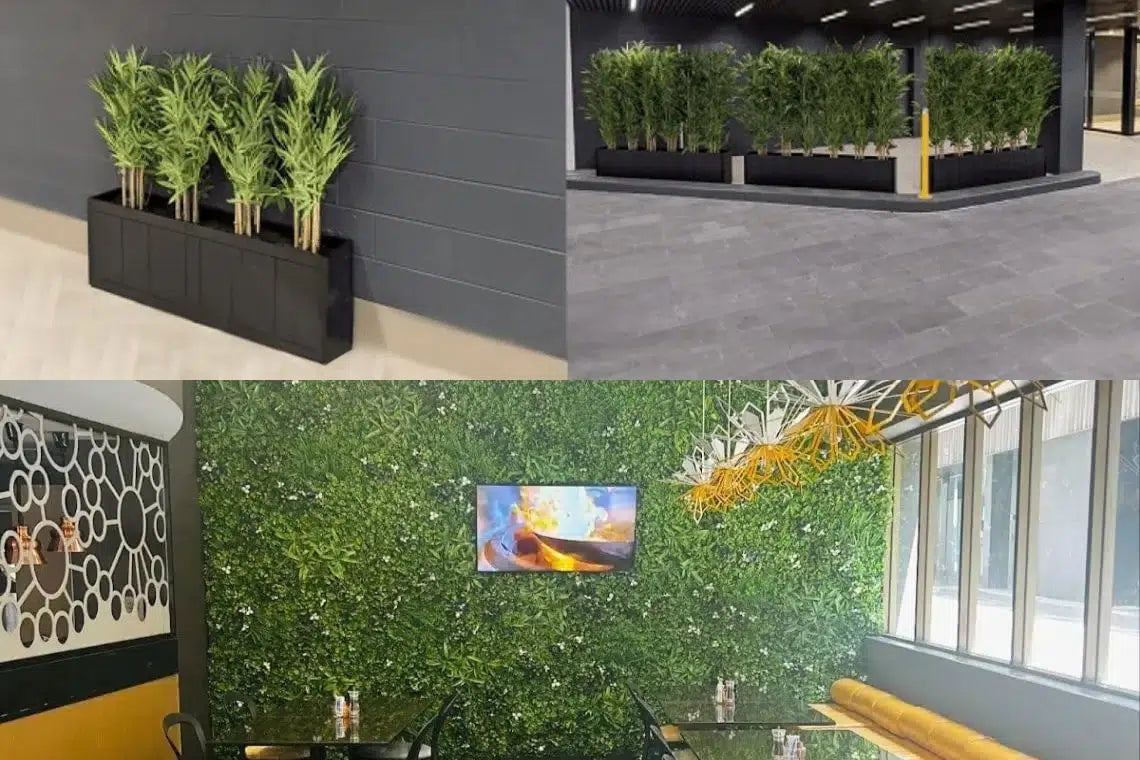
Designer-specified zoning is one of the most cost-effective fixes available to hotel interior designers, and it’s surprisingly easy to do with greneery. Bamboo trees, topiary installations, and freestanding plant columns can define zones without the cost or permanence of a structural intervention.
 You can separate seating clusters from the main circulation path by a row of planters to get a more private and more considered space for the people lingering.
This was the approach used in the Mercure Melbourne Doncaster installation, where our team used artificial bamboo trees and green walls to create dining area separation that achieved a private, resort-like atmosphere without hard partitions.
 For help calculating exactly how many panels or plants your specific lobby layout needs, use our commercial panel calculator on each product page.
Mistake 4: An awkward “feature wall” bending the reception desk
The reception desk is the focal point of every hotel lobby. Whatever is on the wall behind it is the first thing guests see from the entrance and the backdrop to every check-in interaction.
When that wall is a flat painted surface, a dated mural, or a generic brand graphic or logo, it misses a significant opportunity.
 An artificial green wall behind the reception desk is the single highest-impact greenery intervention available in a hotel. It creates immediate visual depth, communicates a commitment to quality and design, and transforms the check-in moment into an experience.
The Accor Group is a strong example of this at work: the team selected the White Oasis Artificial Green Wall for its hotel café feature wall and achieved a vibrant, revitalised atmosphere that covered a previously uninspiring grey mural.
 Mistake 5: Ignoring air quality and allergies
Hotel guests, particularly in the travel, wellness, and luxury segments, are more aware of their indoor environment than any previous generation. Air quality, allergen exposure, and the use of non-toxic materials in shared spaces are genuine considerations for a growing proportion of your guests.
Live plants, while biophilically positive, introduce soil microbiota, moisture, and organic particulates into the lobby air. Poorly maintained live plants introduce mould and fungal spores, and certain plant species produce allergens that can trigger reactions in sensitive guests.
Our’ commercial range is engineered with SafeTex non-toxic certification, so it carries no allergens, no pollen, no harmful substances, and no chemical treatments. Every panel is manufactured from LDPE certified to ISO, REACH, and RoHS guidelines.
 They emit nothing, require no chemical maintenance treatments, and contribute no biological content to your lobby’s air quality. This is particularly relevant for hotels operating in the healthcare-adjacent segment: resort spas, wellness retreats, medical properties, and hotels with allergy-sensitive guest profiles.
Mistake 6: Greenery outdated in scale or style
The final mistake is the subtlest, and one of the most common in lobbies that were renovated more than 5 years ago. This is where we see greenery that was fashionable in 2015. A small potted plant in a corner that made sense for a residential space but reads as undersized in a double-height lobby.
In hospitality design, scale and currency matter enormously.
Our commercial range is consistently updated to reflect the panel styles and botanical compositions that interior designers and architects are currently specifying, and many products in the range are UV-resistant and fire-retardant to the specification standards required for commercial hotel environments.
If your lobby greenery is looking dated, a consultation with our team is the most efficient starting point. We’ll assess what’s currently installed, what the lobby’s spatial and brand parameters are, and what a refresh looks like in practice. Book your free commercial design consultation here.
Why Hotels Choose Designer Plants
The decision to specify designer-preferred artificial greenery for a hotel lobby isn’t primarily a design decision, but an operational one. Hotel operators who have worked with us consistently cite 3 factors:
- Longevity and consistency. Our commercial-grade panels carry a 5-year UV warranty and can perform for 15+ years indoors. A lobby greenery installation that looks identical on day one and years later removes a recurring capital expenditure from the property management plan entirely.
- Zero maintenance obligation. Hotel operations teams have no capacity for horticulturalist scheduling. Artificial greenery requires no watering, no pruning, no repotting, and no replacement. Occasional dusting is the full maintenance obligation.
- Sustainability credentials. Designer Plants is committed to sustainable manufacturing, so our panels are recyclable, and research shows our artificial vertical gardens emit only 20% of the overall emissions of a comparable living green wall over their lifetime
Finishing Thoughts
A hotel lobby is never just a lobby. It’s the first and last impression a guest carries. It’s the space your team works in every day, the backdrop to every check-in photo, every social media story, and every repeat-booking decision.
When it’s right, guests feel it without articulating it. When it’s dated, they feel that too.
The 6 mistakes in this guide are highly fixable. In most cases, the fix is faster, more cost-effective, and longer-lasting than any conventional renovation approach, because high-quality artificial greenery is a permanent installation.
Mercure did it. Accor did it. Hundreds of Australian hotel operators have done it. The conversation that starts it all is free, and the showroom is open for visits and advice.
[vc_row][vc_column][vc_tta_accordion section_title_tag=”h3″ active_section=”-1″ title=”FAQs”][vc_tta_section title=”What type of artificial plants are best for hotel lobbies?” tab_id=”1781865951655-e6aff9dc-5af2″][vc_column_text css=””]For hotel lobbies, designer-specified floor-to-ceiling green wall panels, large-format architectural plants (bamboo, palms, ficus), and zoning planters are the most effective choices. Scale is critical for spaces like these, as undersized products will lose their impact in double-height or large-format lobby spaces.[/vc_column_text][/vc_tta_section][vc_tta_section title=”Are artificial plants suitable for 4 and 5-star hotel environments?” tab_id=”1781865951664-f4946af4-dc49″][vc_column_text css=””]Yes, provided they’re commercial-grade. At Designer Plants, we supply brands like the Mercure Hotel, the Accor Group, BMW, and thousands of commercial clients globally. Our panels are engineered from LDPE with RealTex foliage technology that is virtually indistinguishable from live botanical at touch and distance – the quality standard required for high-end hospitality specification.[/vc_column_text][/vc_tta_section][vc_tta_section title=”Do hotel lobby artificial plants require fire certification?” tab_id=”1781866145231-2dc16f6c-5de1″][vc_column_text css=””]In most commercial hotel environments, fire-retardant material certification is required for interior décor. Our Designer Plants commercial range is fire-retardant, with Group 1-standard documentation available for properties requiring formal fire compliance certification. For the best results, confirm your specific requirement with our commercial team before ordering.[/vc_column_text][/vc_tta_section][vc_tta_section title=”How quickly can a hotel lobby greenery installation be completed? ” tab_id=”1781866147097-aafa9d06-2d66″][vc_column_text css=””]For stock-product installations, panels dispatch same or next day from our Braeside, Victoria warehouse. Victoria, NSW, and ACT delivery is 1–3 days. Installation time depends on your coverage area, but most commercial lobby installations are completed in a few days. For custom or bespoke specifications, lead times are 12–16 weeks. Contact our team to confirm availability and scheduling for your project.[/vc_column_text][/vc_tta_section][/vc_tta_accordion][/vc_column][/vc_row]