
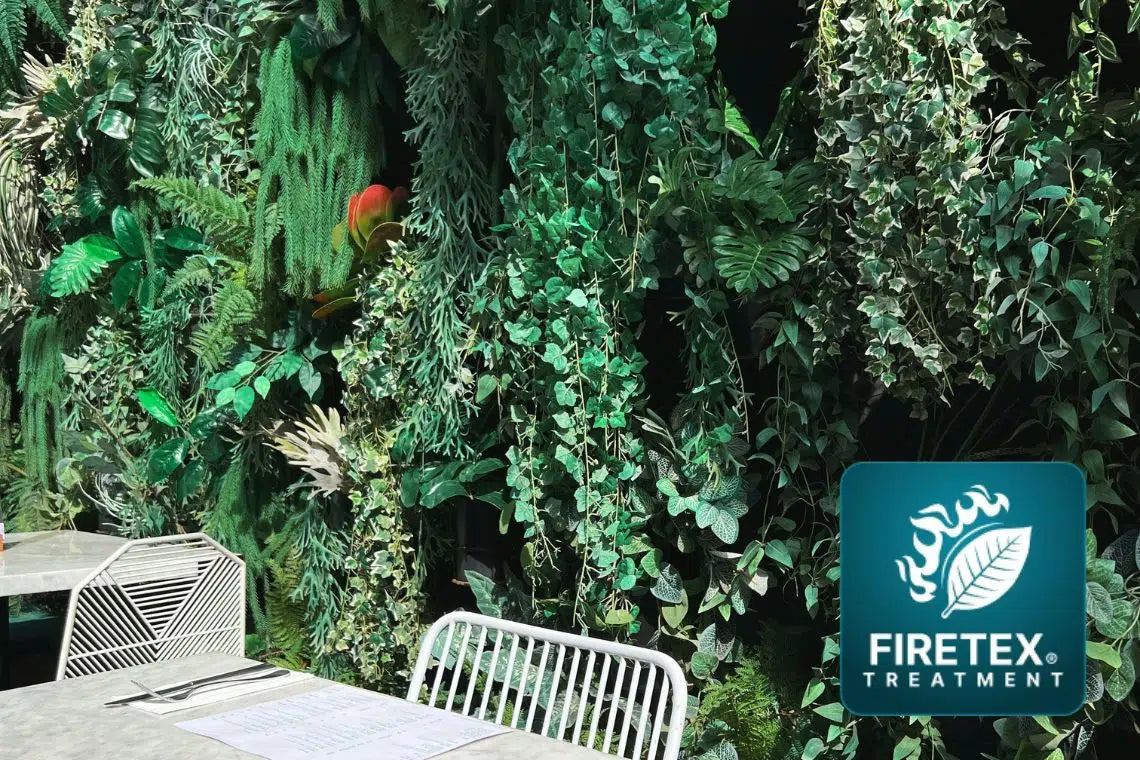
You’ve found the perfect green wall for your project.
The foliage is dense and realistic, the colour is right, the price fits the budget, and then your fire engineer, building certifier, or landlord asks for the fire test report. And the supplier either goes quiet, sends a vague marketing claim, or admits the product hasn’t actually been classified at all, but they sold it to you anyway.
This is the moment that derails more commercial greenery projects than any design decision ever does.
And the funny thing is, fire-rated artificial greenery isn’t even hard to find, but most buyers don’t know what they’re meant to be asking for until the order is already placed or the product has already gone on the wall and the building inspector flags it during sign-off.
 If you’re specifying greenery for a commercial project, fire classification determines what you’re legally permitted to install.
Here’s what you need to know and what you should ask your supplier before committing to a commercial order.
What Does “Fire-Rated” Mean for Artificial Greenery?
Not all “fire-resistant” claims are equal, and this is the single most important thing to understand before specifying greenery for any commercial space.
Fire-resistant doesn’t mean fireproof. It means a material has been independently tested and shown to resist ignition, limit flame spread, and self-extinguish rather than continuing to burn and propagate fire.
Untreated faux plants can catch fire if exposed to sufficient heat, but premium artificial plants can be engineered with fire-retardant additives that change how the material behaves under flame.
If a fire-retardant artificial vertical garden is exposed to flame, the material won’t propagate it. Instead, the panel will char, extinguish, and stop the fire from spreading further. That’s the standard for fire-rated greenery and the standard that matters for compliance purposes.
Some of the critical questions for commercial projects are these:
- How was that fire resistance achieved?
- Can the supplier prove it with independent test documentation?
- Can they explain the difference between surface-applied treatments and integrated fire-retardant technology?

Since we’ve been working with commercial fitouts for over 20 years, we created our own technology called FireTex, which encompasses everything related to fire resistance in one place.
FireTex: Built-In Fire-Resistance for Commercial Faux Green Walls
Our fire-retardant technology was developed by a research and development team specifically to meet the growing demand for safe greenery in modern commercial environments.
The key distinction for your project is this: FireTex integrates fire-retardant compounds directly into the polymer during manufacturing, rather than applying them as an after-purchase spray or surface coating.
This is crucial because surface treatments degrade. A sprayed-on fire retardant can wear off with handling, cleaning, sun exposure, or just with regular wear and tear. Because FireTex is engineered into the polymer itself, its performance remains consistent over time under normal indoor conditions, since it’s part of the product and not applied afterward.
At Designer Plants, we hold the highest certification for fire resistance possible in Australia, the Group 1 certification, which guarantees that our products are safe and recommended for use in commercial spaces.
 Group 1 vs. Group 2: What the classification system tests
In Australia, the fire performance of surface lining materials used in commercial and public buildings is assessed under the Building Code of Australia using a standardised test: AS ISO 9705, the full-scale room corner test.
This test exposes a material to a 100kW fire for 10 minutes, then increases the fire’s output to 300kW for a further 10 minutes, measuring how the material behaves under escalating heat.
The result of this test determines the material’s Group Number (1 through 4), where the lower the number, the better the material performs in a fire:
| Classification | What It Means |
| Group 1 | The material does not reach flashover during the full test sequence. This is the highest and best-performing classification available. |
| Group 2 | The material reaches flashover later in the test sequence than lower-performing materials, but earlier than Group 1 materials. Permitted in many, but not all, commercial applications. |
| Group 3 / Group 4 | Progressively lower fire performance, with earlier flashover times. More restricted in where they can legally be specified. |
“Flashover” is the point at which a fire reaches near-simultaneous ignition of most combustible material in an enclosed space, i.e., the moment a contained fire becomes an uncontrollable room fire.
A material that achieves Group 1 classification does not reach that point during the full duration of the standardised test. That is a safer performance outcome than a product that reaches flashover at some point during testing but still passes a Group 2 threshold.
For certain applications under the National Construction Code, only a Group 1 classification is accepted. For other commercial applications, Group 2 or Group 3 materials are permitted, generally subject to additional conditions such as sprinkler protection or supplementary fire engineering measures.
 The right classification for your project depends on the specific building class, the application (wall lining versus a decorative attachment, for instance), and whether the building has a complying sprinkler system. A fire engineer or building certifier should confirm the requirement for your specific project.
The importance of a test result
In any case, never rely solely on a fire-resistance claim or a label. Ask for the fire test report from your chosen supplier to prove that the products underwent independent laboratory testing.
A trustworthy supplier should be able to provide lab documentation for the specific product you’re purchasing and explain those results clearly. If a supplier can’t or won’t produce that documentation, that’s a signal worth taking seriously.
 At Designer Plants, we send fire testing reports directly by email for the relevant products, specifically so the documentation reaches verified commercial buyers rather than being published openly online and stolen by competitors.
If fire safety is part of your project brief, the practical next step is straightforward: request the fire-rating report for the specific artificial green wall or plant you’re considering, and work from verified documentation rather than assumptions.
Why Fire Resistance Matters Beyond Compliance
Fire performance is increasingly becoming a practical consideration shaped by Australia’s broader climate risk profile.
As bushfire seasons intensify every year and building and landscaping choices near fire-prone areas come under greater scrutiny, the materials specified in and around commercial buildings are reasonably assessed as part of overall fire risk management.
This doesn’t mean artificial greenery prevents bushfire damage; no decorative product can claim that, and we’d never make such claims. What fire-tested, Group 1-certified artificial greenery does provide is assurance that the material, in the event of a fire within or near the building, won’t behave as an accelerant or contribute to flame spread.
And for your safety, that’s the best you can do for your space and the people in it.
Where Fire-Rated Faux Greenery Is Required
Based on the commercial projects our team works on regularly, fire-rated artificial greenery is most frequently specified in:
- Hospitality venues, like hotel lobbies, restaurant feature walls, and bars, where high guest occupancy and public-building classification typically bring stricter fire compliance obligations.
- Retail precincts, like flagship stores, shopping centre tenancies, and mall installations, where landlord fire compliance requirements often dictate the minimum acceptable Group classification for any added decorative material.
- Corporate offices, particularly reception areas and feature walls in office buildings, where building management requires documentation for any new material introduced to common or tenanted areas.
- Healthcare and aged care facilities, as public-occupancy buildings of this nature, sit at the higher end of fire compliance scrutiny, given the building classification and occupant profile.
 You can browse our dedicated fire-tested artificial plants range to see which products are available with fire-rated certification.
How Designer Plants Work With Commercial Projects
Every commercial client works directly with a Designer Plants stylist throughout the entire project, from the initial brief and fire classification requirements, through product selection and sample approval, to the final installation and handover.
Your plant stylist will help you understand which products in our range meet your required Group classification, source the correct documentation, and ensure the final installation is intentional.
Your single point of contact continues through to delivery and installation support, so nothing gets lost between the design brief and what goes on the wall. And at any point during the process, our team will gladly assist you in our showroom.
[vc_row][vc_column][vc_tta_accordion section_title_tag=”h3″ active_section=”-1″ title=”FAQs”][vc_tta_section title=”What does a Group 1 fire rating mean for artificial plants? ” tab_id=”1782471137830-1743c0e0-f943″][vc_column_text css=””]Group 1 is the highest fire performance classification under the Australian Group Number system, assigned when a material does not reach flashover during the full AS ISO 9705 test sequence (100kW for 10 minutes, followed by 300kW for a further 10 minutes). It’s the best possible classification a building or decorative material can achieve under this standard.[/vc_column_text][/vc_tta_section][vc_tta_section title=”What’s the difference between Group 1 and Group 2 fire ratings? ” tab_id=”1782471137834-628f5fbd-10ed”][vc_column_text css=””]Both classifications are derived from the same AS ISO 9705 test, but Group 1 materials do not reach flashover at any point during the full test, while Group 2 materials reach flashover later in the test sequence than lower-performing materials. Group 1 is permitted in a broader range of commercial applications, including some where Group 2 is not accepted, depending on building class and other fire safety provisions.[/vc_column_text][/vc_tta_section][vc_tta_section title=”Is FireTex a spray-on fire treatment? ” tab_id=”1782471253384-316b82e4-398f”][vc_column_text css=””]No. FireTex integrates fire-retardant compounds directly into the polymer at the manufacturing stage, rather than as an after-purchase spray or surface coating. This is what allows its fire performance to remain consistent over the life of the product, rather than degrading with handling, cleaning, or time.[/vc_column_text][/vc_tta_section][vc_tta_section title=”Do I need Group 1 certified greenery for my commercial project? ” tab_id=”1782471291241-fbefa89b-63e7″][vc_column_text css=””]It depends on your building classification, the specific application, and whether your building has a complying sprinkler system. Some commercial applications require Group 1, while others permit Group 2 or Group 3 under certain conditions. We recommend confirming the exact requirement with your fire engineer, architect, or building certifier, then speaking with our team about which product matches that classification.[/vc_column_text][/vc_tta_section][vc_tta_section title=”How can I verify a fire-resistance claim before I buy? ” tab_id=”1782471357451-dd533bf7-f6ce”][vc_column_text css=””]Always request the independent laboratory test report for the specific product, not just a general claim or label. A reputable supplier should be able to provide this documentation upon request. We send fire testing reports directly to commercial clients on request for the relevant products in our range.[/vc_column_text][/vc_tta_section][/vc_tta_accordion][/vc_column][/vc_row]