
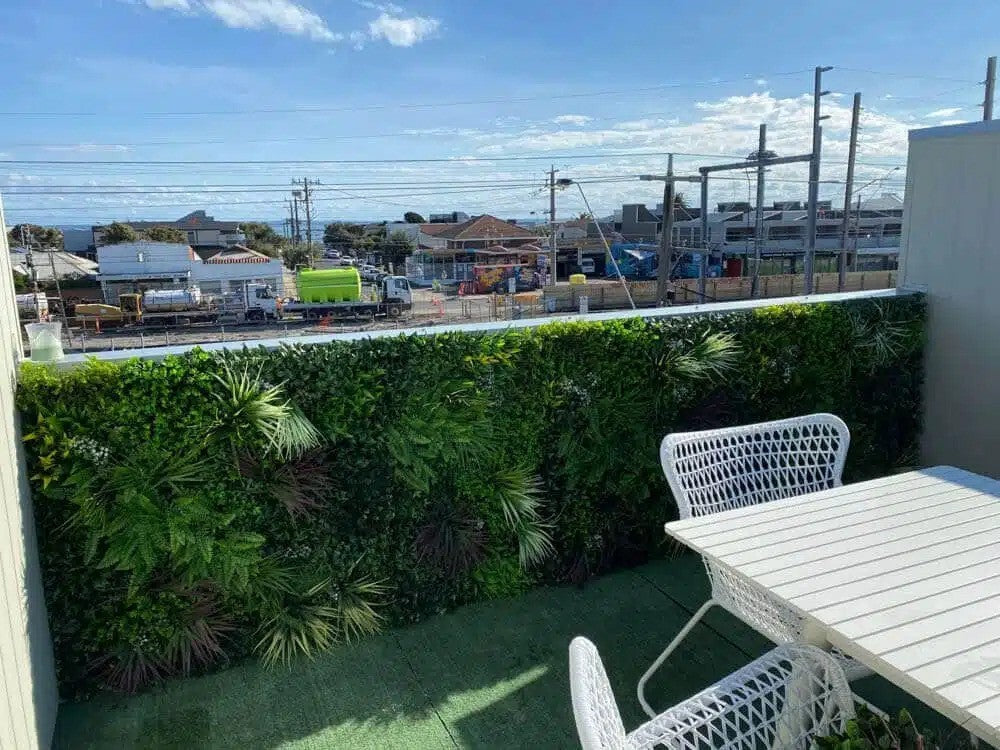
Your green wall might look perfect today, but if it isn’t a UV-resistant green wall, the countdown to fading, cracking, and shedding has already started. What most people miss is that sunlight does not damage an installation overnight. It works gradually, reducing colour depth, weakening flexibility, and slowly turning a lush feature into something that looks tired and uneven.
Two panels can look identical on day one. Same density. Same colour. Same visual impact. Yet one holds its appearance for years while the other begins to fade within months.
The difference is material engineering, not appearance. And in Australian conditions, that difference determines whether your artificial green wall remains a feature or becomes a replacement project far sooner than expected.
If you are planning a vertical garden, the decision between a UV-resistant and a non-UV-resistant green wall is a factor that decides longevity, consistency, and long-term value.
You will learn:
- Why sunlight affects artificial green wallfoliage faster than most expect
- What separates UV-engineered panels from standard ones
- Where non-UV-resistantgreen wall installations fail first in Australian environments
- When protection sprays add value and when they do not
- How to choose the right solution based on placement rather than price
Why Sunlight Is the Risk Most Buyers Miss
Sun exposure is the primary reason many outdoor artificial green wall installations lose their appeal early. Heat plays a role, but ultraviolet radiation causes the structural damage. It breaks down pigments and dries out the polymers that keep leaves flexible.
Damage begins from the first day of exposure. It does not require extreme weather. Even moderate daily sunlight accumulates an impact over time.
High-risk locations include:
- North and west facing fences
- Pool areas where light reflects off water
- Balcony walls exposed to afternoon sun
- Commercial façades with full-day exposure
- Indoor areas with strong natural light through large windows
Once fading and brittleness begin, the material cannot recover. Cleaning improves appearance temporarily, but structural decline continues.
How a UV-Resistant Green Wall Holds Its Colour and Structure
A true UV-resistant green wall is engineered at the material level. Protection is blended into the plastic during manufacturing rather than applied to the surface.
This internal stabilisation slows degradation and keeps the structure flexible even under intense Australian sun.
You will notice the difference over time:
- Colours remain deep instead of turning chalky
- Leaves stay flexible rather than snapping
- Backing panels maintain shape without warping
- Overall density remains consistent
Panels such as the Green Tropics Vertical Garden or the Mediterranean Fern Vertical Garden are designed for indoor and outdoor use with dense foliage and strong backing mesh for long-term stability.
Their modular 1m x 1m format also allows easy installation and expansion without visible joins.
For projects that demand a stronger visual impact, Luxury Lush Spring Vertical Garden add layered foliage and high-density coverage, helping maintain a full appearance even after years of exposure.
Where a Non-UV Resistant Green Wall Fails First
A non-UV-resistant green wall is designed for controlled interiors where sunlight exposure is minimal. Problems begin when these panels are installed outdoors or near strong natural light.
The decline follows a predictable pattern:
- Colour loses depth and contrast
- Leaf edges stiffen and curl
- Stems snap during wind or handling
- Backing becomes brittle and distorted
- Shedding begins, and gaps appear
Even indoor installations can deteriorate if placed near glass walls, skylights, or reflective flooring. Light intensity matters more than whether the space is technically indoors.
Once degradation becomes visible, replacement of the entire section is usually required to restore a consistent appearance.
The Same Wall Over Time
| Year | UV-Resistant Green Wall | Non-UV Resistant Green Wall |
| 0 | Lush colour, full density, natural depth | Lush colour, full density, natural depth |
| 1 | Colour holds, leaves remain flexible | Greens begin to dull, surface looks flat |
| 2 | Still presentable, consistent coverage remains | Fading is obvious, leaves feel stiff, patchiness starts |
| 3 | Minor softening in tone | Significant colour loss, leaf drop likely, replacement needed |
How UV-Resistant Green Wall and Non-UV-Resistant Green Wall Age Over Time
Performance differences become clear when installations are compared over time.
| Exposure Condition | UV-Resistant Green Wall | Non-UV Resistant Green Wall |
| Daily Direct Sunlight | Colour stays rich, material remains flexible | Rapid fading, leaves become brittle |
| Partial Sunlight | Slow and even ageing occurs | Patchy fading, colour becomes uneven |
| Bright Indoor Light Near Windows | Minimal visible change is observed | Localised fading appears near light source |
| Heat And Reflective Glare Zones | Panels hold shape and structure | Warping, cracking, and distortion develop |
| Long Term Appearance After Years | Dense, consistent coverage is maintained | Foliage thins and leaves shed |
Uneven ageing is the main reason partial replacements rarely match older sections.
The Australian Exposure Test that Decides Everything
Australia’s UV levels are among the highest in the world. Exposure assessment is essential before choosing any vertical garden green wall.
Ask three questions:
- How many hours of direct or indirect sunlight reach the surface?
- Which direction the wall faces?
- How difficult replacement would be later?
If the area receives natural light at any point during the day, UV-resistant green wall protection should be treated as essential. Non-UV-resistant green wall panels should be limited to enclosed interiors with controlled lighting.
How Appearance Changes with Sun Exposure
The difference between protected and unprotected panels becomes visible over time.
UV-protected installations age gradually and evenly. Colour softens slowly but remains consistent.
Non-UV installations decline quickly. Colour fades early, structural stiffness follows, and thinning becomes noticeable within a much shorter period.
Density also plays a role. High-density panels such as the Flowering White Jasmine Fake Green Wall help shield lower layers from light exposure while maintaining privacy and visual fullness.
When a UV Protection Spray Adds Value
Surface protection products are useful in specific situations. They extend the lifespan of materials but do not replace built-in UV stabilisation.
They work well for:
- Decorative elements in partial sun
- Older installations that need additional protection
- Non-UV-resistant green wallproducts that must remain in brighter areas
The Home Safe UV Protection Spray forms a clear protective layer that helps maintain colour and flexibility. It is easy to apply and suitable for artificial green walls, furniture, and decorative features.
However, surface treatments cannot reinforce internal structure. For full outdoor installations, UV-engineered panels remain the stronger, long-term solution.
Why Density Matters
Panel density affects privacy. It directly influences longevity.
Thicker foliage reduces light penetration and protects inner layers. It also helps conceal gradual ageing and maintains visual impact for longer.
High-density panels are ideal for:
- Boundary fencing
- Commercial screening
- Balcony privacy walls
- Feature installations exposed to the sun
Dense modular systems also allow custom sizing by cutting along the backing grid, making them adaptable for complex spaces without compromising coverage.
Why Cheap Panels Become a Long-Term Problem
Short-term savings often lead to early replacement.
When panels degrade unevenly, colour mismatches become obvious. Partial replacement rarely blends with older material. Removal, disposal, and reinstallation add disruption and labour.
UV-engineered materials avoid this cycle by ageing evenly and maintaining structural integrity for longer periods.
Why Indoor Placement Does Not Always Mean Protection
Indoor installations are not automatically safe.
Risk increases when:
- Large windows allow direct sunlight
- Skylights focus light onto a wall
- Reflective surfaces amplify brightness
In these situations, UV-stabilised panels maintain a consistent appearance and prevent localised fading near light sources.
This is particularly important for offices, cafés, retail spaces, and reception areas where visual consistency matters.
How to Choose Based on Placement
Use placement as your primary decision factor:
Choose UV-engineered panels if:
- The wall receives any natural light
- Replacement would be disruptive
- Long-term appearance matters
Reserve non-UV-resistant green wall panels for fully enclosed interiors with controlled lighting and no sun exposure.
This simple placement-first approach prevents early deterioration and protects the overall investment.
Final Word
The difference between a UV-resistant and a non-UV-resistant green wall determines how your artificial green wall performs in real Australian conditions.
Sun exposure works every day, and once material breakdown begins, recovery is not possible. Choosing UV-engineered panels protects colour, structure, and consistency throughout the entire installation.
If long-term performance matters, this decision is non-negotiable. With Designer Plants, we create panels engineered to withstand Australian conditions, so your vertical garden green wall remains a dense, lush, and visually striking feature rather than a maintenance headache.
A green wall that fades is a costly reminder of shortcuts.