
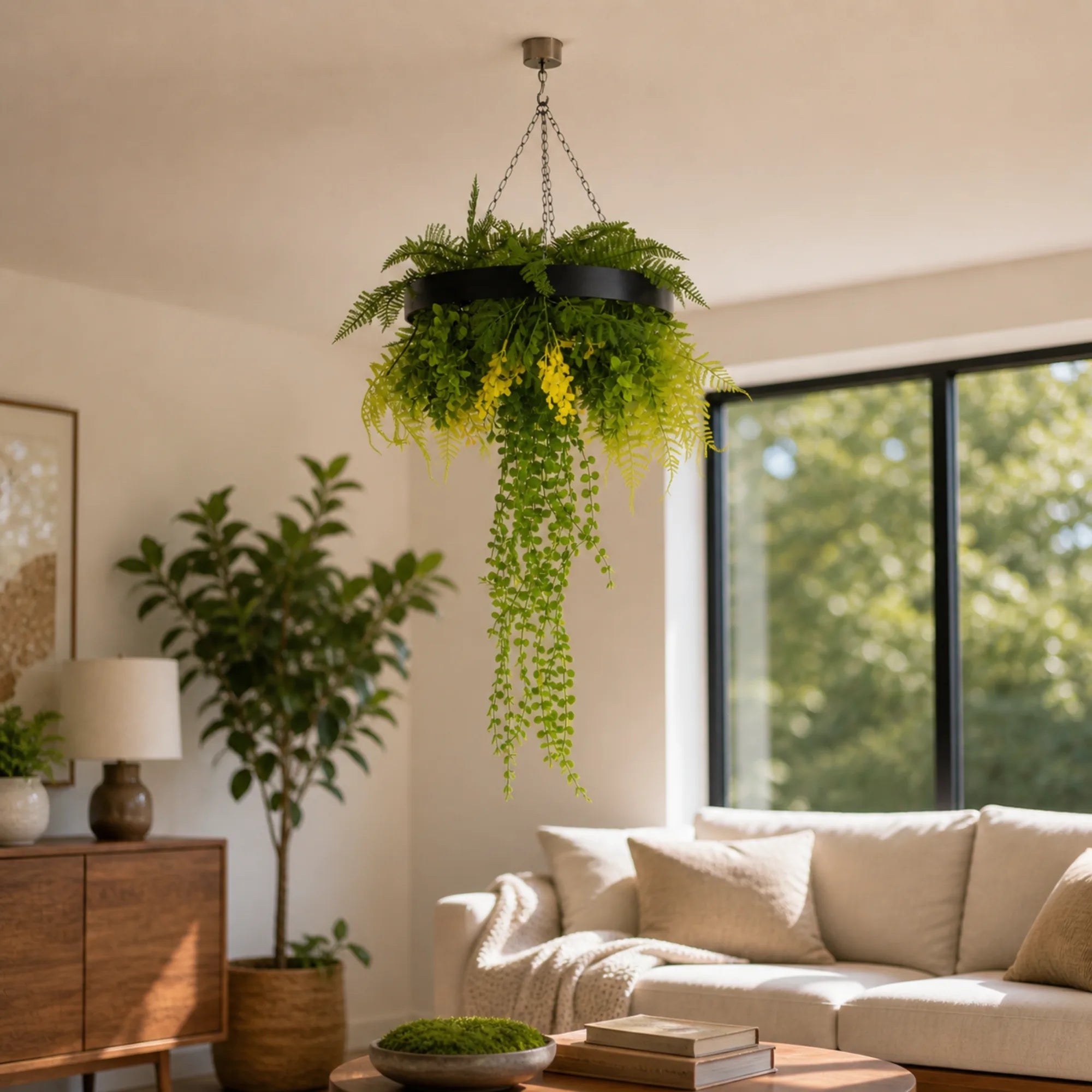
A garden that holds its shape without daily input comes from removing variables that cause visible decline. Most outdoor spaces start to look off when growth, colour, or structure shifts faster than it is corrected. A low maintenance garden is built to slow those shifts or make them less noticeable. The aim focuses on reducing moments where the space demands attention to look acceptable, even when you are relying on artificial indoor plants to stabilise the look.

Build A Garden That Does Not Need Babysitting
Maintenance is driven by change. The faster elements change, the more often you step in.
Reduce change at the source.
- Limit plant types so growth patterns remain consistent across the space
- Repeat the same forms to create visual order that holds even when one section shifts
- Use dense fillers at boundaries so gaps do not appear suddenly
- Keep edges defined so zones do not blur over time
Visual contrast is the first thing the eye detects. Bare patches next to dense foliage stand out immediately. Filling those transition areas reduces how often flaws become visible.
The Artificial Boston Hanging Fern 102cm works here by occupying vertical gaps where contrast usually appears first. It stabilises the visual field, so small inconsistencies elsewhere are less noticeable. This also explains why hanging indoor plants are used strategically in tight layouts where ground clutter would otherwise expose flaws.
Lawns Look Good Until They Don’t
A lawn is evaluated by three factors at once. Colour, height, and density. Each changes at a different rate.
Trying to maintain all three equally increases time spent on upkeep.
A better approach controls which factor dominates visually.
- Frame lawns with darker greenery to reduce visible colour variation
- Break large lawns into smaller sections so uneven growth is less obvious
- Use hard edges so the shape remains defined even if density drops
Placement also matters. Lawns in direct sightlines are judged constantly. Moving them slightly away from entry views reduces how often their condition affects the overall impression.
This shifts attention from perfection to composition.

Use Vertical Greenery Like You Mean It
Horizontal layouts concentrate attention at one level, which makes inconsistencies easier to detect.
Vertical layering distributes that attention.
When the eye moves across multiple heights, it stops focusing on a single imperfect area.
Placement should follow structural lines.
- Install greenery where surfaces meet to soften transitions
- Use trailing forms to break rigid edges created by walls and rails
- Extend greenery across sections to create continuity
The Bright Mixed Artificial Philodendron Garland Bush 100cm is effective in transitional zones because it connects separate surfaces into one visual plane. This placement aligns well with artificial hanging plants indoor setups, especially along rails and wall joins where visual breaks tend to appear.

Design So It Still Looks Good When You Ignore It
Visible decline often starts with movement. Leaves droop, edges lose definition, and shapes become irregular.
Reducing movement reduces visible decline.
- Choose elements that retain structure without daily adjustment
- Avoid focal points that rely on constant upkeep
- Layer the design so one area does not control the entire visual outcome
Repetition also reduces perceived disorder. When forms repeat, minor variations appear intentional rather than neglected.
The Artificial Watermelon Peperomia Hanging Vine maintains consistent shape and colour, which avoids introducing new variables that require attention.
Stop Replanting Every Few Months
Seasonal planting introduces continuous change. Growth stages create periods where the garden looks incomplete.
Maintain a stable visual base to avoid this.
- Keep core greenery consistent throughout the year
- Use seasonal plants as accents rather than primary structure
- Design layouts that look complete without relying on growth stages
This keeps the garden in a finished state at all times instead of shifting between phases. Many homeowners rely on artificial indoor plants here to lock in that consistency across seasons without reworking the layout.
Add Texture Without Adding Work
Texture influences how surfaces interact with light. Flat foliage reflects light evenly, which can make areas appear flat under strong sunlight.
Variation in texture breaks this uniform reflection.
- Broad leaves provide visual stability
- Fine, irregular forms reduce uniformity
- Draping elements create depth without increasing density
The Artificial Air Plant / Spanish Moss (Old Man Beard) 60cm introduces irregular lines that scatter light, which adds depth without adding maintenance requirements. This effect often pairs well with hanging indoor plants that introduce layered height without increasing density on the ground.
Cover More Space Without Growing More Plants
Incomplete coverage is one of the main reasons a garden feels unfinished.
Waiting for plants to grow delays visual completion while still requiring upkeep.
Immediate coverage solves this.
- Use long trailing elements to span large areas
- Fill gaps early to prevent uneven development
- Create continuous lines to guide visual flow
The Ivy Garland Vines 260cm Each – 5 Per Pack provide extended coverage that reduces visible gaps and establishes structure from the start. These are commonly used in artificial hanging plants indoor arrangements where large surfaces need quick visual coverage without long growth cycles.
Every Element Needs a Reason to Exist
Visual clutter occurs when elements do not support a defined role.
Assign clear functions to each component.
- Structural elements define layout
- Fillers close gaps
- Softeners reduce harsh edges
- Connectors link separate zones
Elements without a role create conflict and increase perceived disorder.
Clarity in function maintains visual order.
Think Like a System Not a Collector
A collection grows without coordination. A system is organised around relationships.
In a system, each part supports the whole.
- Transitions between zones are smooth
- Height changes are gradual and intentional
- Colour and form repeat across sections
This creates continuity, and when continuity is present, isolated issues become less noticeable because attention is distributed across the entire space. This is often where artificial indoor plants are used repeatedly to maintain uniformity without introducing variation.
Time Is the One Thing You Do Not Get Back
Most garden tasks are small but repetitive, and their frequency creates the burden.
Reducing repetition is more effective than reducing task size.
A low maintenance garden removes recurring adjustments by stabilising elements, which reduces the number of interventions required to maintain appearance and keeps the space usable without preparation.
Time Is the One Thing You Do Not Get Back
- Designing layouts that depend on continuous growth to appear complete
- Using plant types with inconsistent growth behaviour in the same space
- Leaving visible gaps that expose minor flaws
- Placing high maintenance elements in areas of constant visibility
- Ignoring how light conditions affect how imperfections are perceived
Each increases the frequency of required intervention.
Final Word
A low maintenance garden is defined by stability. Stable structure, stable appearance, and reduced need for correction. When these are in place, the space maintains itself visually. If you want that level of control, we at Designer Plants provide greenery that holds its form, maintains consistent appearance, and adapts to outdoor conditions without adding ongoing demands. This approach removes recurring work and keeps the garden in a finished state at all times.
We give you a garden that minds its business while you mind yours.