
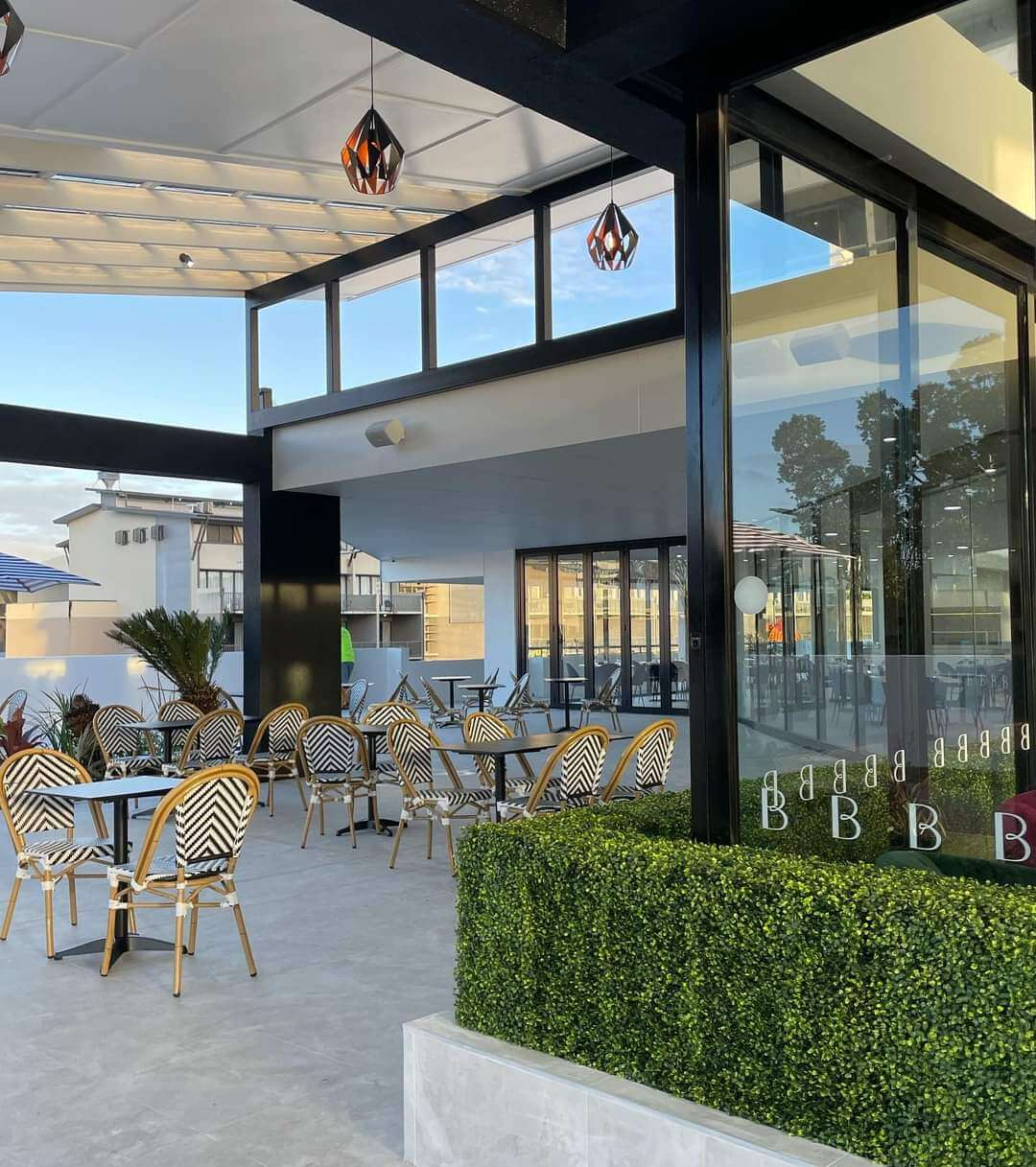
You've just sat down at a cafe you've never been to. The table's outside, tucked behind a thick green wall. Coffee hasn't arrived yet, but the street noise is muffled, no one's brushing past your elbow, and whoever designed this made it feel like an actual space instead of just a footpath table. You'll probably come back. That green wall is almost certainly not real. And the cafe owner almost certainly doesn't care, because neither do the customers. Across Australia, cafe owners who've installed artificial hedge walls in their outdoor spaces are getting the same results: better ambience, more repeat customers, a stronger social media presence, and zero gardening bills. It's not a new trend, but it's one that a lot of operators are still sleeping on. This article covers how it works, which products suit which setups, what the real cost difference looks like, and what to know before you buy.
What Customers Want from Your Outdoor Space
When someone chooses a seat outside, they're not just picking a table. They're deciding whether the space feels worth sitting in. Most people can't articulate exactly what makes one outdoor area feel better than another, but they know it when they feel it. The cafes that consistently fill their outdoor tables tend to share a few things in common:
- A boundary between the table and the street:It doesn't have to be tall. Even a low hedge row signals that this space was set up for you, not just left open.
- Some privacy between tables:People on work calls, couples catching up, anyone who doesn't want to be overheard. A visual break between table groups goes a long way.
- Something worth photographing.A green wall behind a coffee or a plate gets posted. That's customers doing your marketing for you, every single day.
- A space that looks after itself.Dead plants, patchy hedges, overgrown pots. Customers clock these things and they affect how the food is perceived, too.
- Less street noise.A solid hedge screen takes the edge off nearby traffic. Small difference, but people comment on it.
A well-positioned artificial hedge wall ticks all of these without a weekly task list attached to it. That's the core of why it works so well in a commercial setting: it delivers the outcome customers respond to without creating ongoing work for the operator.
Why Real Plants Are More Trouble Than They're Worth in a Commercial Space
The upkeep never stops
A real boxwood hedge needs trimming every 6 to 8 weeks through spring and summer. At $80 to $150 per visit, depending on your city, that's $500 to $1,000 a year in trimming alone, and that's before you add watering, fertilising twice a year, pest treatments when aphids or psyllids get into the plants, and the odd replacement when something dies back. Most cafe owners don't tally these costs when they put the original plants in. By year two or three, they usually have a clearer picture.
Australian summers punish plants in containers
Potted plants on concrete heat up and dry out much faster than plants in garden beds. The concrete radiates heat back up from below while the sun hits from above. Something that looks healthy and lush going into November can look stressed, brown, and patchy by February, right through the busiest trading months of the year for most cafes. Perth, Brisbane, Western Sydney. None of these is a forgiving environment for plants in containers sitting on a hot outdoor terrace with no ground moisture to draw from.
When a plant dies, the gap stays for months
You replace it, but the new one is small and obvious for months. It sits there looking out of place next to an established hedge, and you can't speed that process up. In a residential garden, that's fine. In a commercial outdoor space where the area needs to look good every trading day, a three or four month recovery window is a long time. Customers see it, they form an impression, and that impression carries.
Pollen is a problem for some customers
Some hedging species produce enough pollen to cause issues for customers with hay fever or asthma, particularly during spring and early summer. It doesn't stop them visiting once, but it does stop them choosing the outdoor tables again. Over time, that chips away at your outdoor repeat trade. None of these applies to a fake hedge wall. The only maintenance it needs is a wipe down when dust builds up.
Five Ways an Artificial Hedge Wall Changes the Outdoor Experience
1. It turns a footpath into a destination
Tables with no boundary between them and the street feel exposed and unfinished. Running artificial green hedge panels along the perimeter, even low ones, immediately gives the space a defined edge. Customers feel like they've stepped into somewhere, not just sat down near a road. It's a small visual cue, but it shifts how people experience the space. For a low perimeter marker that doesn't block sight lines, the Portable Boxwood Hedge (50cm) is the right choice. If you want something even more understated, the Portable Boxwood Hedge (25cm) gives more of a row-of-planters effect.
2. It gives each table group its own space
Put artificial green hedge panels between table groups and you don't lose a single seat. The tables stay exactly where they are. What changes is that customers in adjacent groups feel less exposed to each other, which matters for couples, people working, or anyone having a conversation they'd rather keep private. The Portable Boxwood Hedge (75cm square) sits on its own base, takes up about the same footprint as a pot plant, and can be repositioned between services without any tools. The Mixed Boxwood Hedge (75cm) is the same height with a slightly more textured foliage look if you want less uniformity between tables.
3. It becomes the most photographed part of your cafe
A full-height artificial hedge wall along the back of your outdoor seating becomes a photo backdrop that works every single day. Customers photograph their coffee, their food, or just the table setting with the green wall behind them, and they post it. Those posts reach their followers. At a busy venue, this happens dozens of times a week without any effort on your part. It's the closest thing to free, ongoing marketing that exists in hospitality right now. The Deluxe Portable Buxus Hedge (2m tall) is the go-to for a strong, clean backdrop. For a less uniform look with more natural variation in the foliage, the Large Mixed Boxwood Hedge (2m tall) achieves the same height.
4. Rooftop and terrace spaces need UV-rated panels
A rooftop or elevated terrace is one of the hardest environments for real plants. Full sun all day, wind, no shelter, and in containers that heat up fast. Cheaper artificial products fade quickly in those conditions, too. The UV-stabilised range is specifically built for extended full-sun exposure. The Deluxe Portable Buxus Hedge (1.5m x 1.5m) and Large Mixed Boxwood Hedge (1.5m x 1.5m) both handle rooftop conditions well, and the larger panel footprint improves wind stability in exposed elevated positions.
5. It takes the edge off street noise
A dense fake hedge wall between your seating and a busy road absorbs mid-frequency traffic noise. It won't silence a tram stop, but sitting behind a well-positioned hedge screen versus sitting in the open is a noticeably different experience. Customers who regularly choose the outdoor tables near the hedge over the ones closer to the street are telling you something. For this application, panel density matters more than height. The Mixed Boxwood Hedge (1m x 1m) and the Deluxe Portable Buxus Hedge (1m x 1m) are the densest options in the range and the best choice for this use.
Which Panel for Which Job
Low perimeter boundaries
The Portable Boxwood Hedge (25cm) for a very subtle row effect, or the Portable Boxwood Hedge (50cm) for a proper defined boundary without blocking sight lines.
Table dividers
The Portable Boxwood Hedge (75cm square) or Mixed Boxwood Hedge (75cm). Both freestand on their own bases and move without tools.
Feature walls and photo backdrops
The Deluxe Portable Buxus Hedge (2m tall) or Large Mixed Boxwood Hedge (2m tall) for full-height backdrop walls. For corners, the Deluxe Portable Buxus Hedge (1.5m x 1.5m) covers a large area per panel with fewer joins.
Full sun and rooftop
The Deluxe Portable Buxus Bright (50cm) or Luxury Deluxe Portable Buxus Bright (75cm). The Bright range is built to hold colour in prolonged direct sun without fading.
Long fence lines and maximum coverage
The Mixed Boxwood Hedge (1m x 1m) gives exactly one square metre per panel, which makes calculating quantities easy. The Deluxe Portable Buxus Hedge (1m x 1m) is denser for a tighter, more uniform finish.
The Cost Comparison: Real Hedge vs Artificial Hedge Wall Over 3 Years
For a 5-metre perimeter run at 1 metre height, which is typical for a small to medium outdoor dining area:
| Real Boxwood Hedge (5m run) | Artificial Hedge Wall (5m run, 1m high) |
| Initial planting: $400-$800 | 5 panels at $449.95 each: $2,249.75 |
| Trimming 8x/year at $120 avg: $960/yr | Installation (DIY): $0-$100 |
| Watering, fertilising, pest control: $200-$400/yr | Annual upkeep: $0 |
| Dead plant replacement: $150-$300/yr | Replacement in 5 year warranty: $0 |
| 3-year total: $4,000 - $5,500+ | 3-year total: $2,250 - $2,350 |
Over three years, the artificial option saves $2,000 to $3,000 on a single 5-metre section. The saving grows from year four onwards because the artificial hedge carries no recurring costs at all. The real hedge keeps accumulating trimming, pest, and replacement costs every year indefinitely. Add in the time spent sourcing a gardener, scheduling visits, chasing them when they cancel, and managing replacements when plants die over summer, and the real cost gap between the two options is wider than the numbers alone show.
What Changes by City
Melbourne
Hot UV summers followed by frosty winters are a rough combination for outdoor plants in exposed positions. A boxwood hedge that looks good in late September can look burnt by late February and suffer die-back by June. The problem is that February and March are peak trading months, and June and July are when a lot of Melbourne's inner-suburb brunch trade is strongest. Melbourne's outdoor dining culture means the space runs hard for most of the year, not just on warm spring days. Artificial panels look identical in every season, which means the outdoor space looks just as good on a cold August lunch service as it does in October.
Sydney and Brisbane
High summer humidity creates mould and fungal problems for real plants in shaded positions, particularly under pergolas and shade sails where moisture lingers. Most outdoor cafe dining areas have at least some shaded spots, and this is exactly where the problem develops. Artificial panels have nothing organic to harbour that kind of growth. Both cities also deliver enough UV through summer to bleach lower-quality artificial products within a season. Quality UV-stabilised panels hold their colour through multiple Australian summers without the green fading to a dull grey tone.
Perth
The combination of intense UV and water restrictions makes consistent commercial hedging genuinely difficult. Plants either look stressed from under-watering during restriction periods or require irrigation costs that add up quickly. Either way, the outdoor space spends a significant portion of the summer looking less than ideal. UV-stabilised artificial panels were essentially designed for Perth conditions: high sun angle, long exposure hours, and restricted water access.
A note on outdoor dining permits
Freestanding portable panels that aren't fixed to the ground or attached to a building generally don't trigger building approvals, and they also don't affect the footprint area specified in most outdoor dining permits. But council rules vary and they do change. Check with your local authority before installing screening above about 1.8 metres or anything that could be classed as a permanent structure. Most operators find the portable range sits well outside the threshold that requires approval.
What Actually Happened at One Cafe
The following is based on common outcomes reported by cafe operators after installing artificial hedge screening. It reflects typical results rather than a single specific venue. A cafe on a busy Brunswick tram road had eight outdoor tables with no perimeter screening and nothing between tables. Customers described the street-side seats as too exposed. Outdoor tables were the last to fill and the first to empty. The owner ran artificial hedge wall panels along the two street-facing sides at 50 cm height and placed square divider panels between every second table pair. One afternoon, two people, under $2,000 all up. Within two weeks, the outdoor tables were filling consistently through morning and lunch service. Customers started specifically mentioning the outdoor space in feedback, which had never happened before. Social media posts from the outdoor area went up noticeably, with the green wall showing in the background of almost every shot. The owner has not called a gardener since, and has not spent anything on maintenance since the day of installation.
Three Setups Worth Knowing
Small footpath cafe, 6 to 8 outdoor tables
Problem: No perimeter screening. Customers sitting near the street feel exposed and tables fill last. Setup: Portable Boxwood Hedge (50cm) end-to-end along the two street-facing sides. Portable Boxwood Hedge (75cm square) between every second table pair. All panels freestand, so no council structure approvals are triggered. Cost: $1,200 to $1,800, depending on perimeter length. One afternoon to install.
Medium courtyard or beer garden, 20 or more tables
Problem: Space trades reasonably but feels unfinished. No visual zones. Customers don't feel like they're anywhere in particular. Setup: Deluxe Portable Buxus Hedge (2m tall) panels along the main boundary walls for full enclosure and a strong feature wall backdrop. Mixed Boxwood Hedge (1m x 1m) panels to define internal seating zones. Cost: $3,500 to $6,000, depending on perimeter length and how many internal zones are created.
Rooftop cafe or elevated terrace
Problem: Full sun, wind, no enclosure. Real plants have failed. Setup: Deluxe Portable Buxus Hedge (1.5m x 1.5m) along the perimeter. Deluxe Portable Buxus Bright (50cm) along table edges. Cost: $4,000 to $8,000. For how artificial greenery performs in a high-traffic commercial environment, the BMW Melbourne case study is worth a look.
Is It Worth It?
Cafe outdoor spaces are income-producing real estate. They work well or they don't, and the difference usually comes down to whether customers want to sit there, come back, and tell others. Real plants are expensive to keep in shape; they fail without attention, and when they look bad, the whole outdoor area looks bad. A fake hedge wall looks the same in July as it does in January. It doesn't need a gardener, it doesn't respond badly to a dry summer, and it doesn't look worse over time. The cost table in this article shows the numbers clearly. On a single 5-metre section, you're looking at a saving of $2,000 to $3,000 over three years compared to real hedging. On a bigger outdoor space, that number scales. And unlike real plants, the cost doesn't keep growing. Once the panels are in, the spend is done. If your outdoor space isn't pulling customers in the way it should, artificial green hedge panels are probably the cheapest and fastest fix available to you right now. One afternoon to install. No ongoing cost. No gardener to call. The change in how the space feels is immediate, and it stays that way.
About Designer Plants
Designer Plants is an Australian-owned supplier of UV-stabilised artificial hedges and green wall panels made for Australian outdoor conditions. The range runs from compact 25cm low dividers to full 2-metre feature wall panels, in both standard and high-UV Bright variants. All outdoor panels carry a 5-year warranty against fading and cracking. Custom sizing is available for non-standard installations.
Common Questions
Are they safe around food?
Yes. UV-stabilised polyethylene, the same material used in food-grade containers. No particles, no pollen, no chemicals.
How long do they last outdoors?
Quality panels carry a 5-year warranty against fading and cracking. In shade or indirect sun, most go well past that. In full north-facing sun, go with the Bright UV range.
Do they need a wall or can they freestand?
The portable range freestands on weighted bases. No fixings needed. For a wall-mounted installation, cable ties through the backing grid work on most surfaces. Brick walls need wall plugs and screws.
What if the standard size doesn't fit?
Custom sizing is available. Get a quote before buying a bulk quantity for a non-standard space, as on-site trimming is not always clean.
How do you clean them?
A damp cloth for dust. Warm soapy water and a soft brush for anything heavier. Once a month is plenty for most outdoor settings.
Do they look fake up close?
At normal viewing distance in an outdoor dining setting, no. The mixed foliage variants with varied leaf shapes and tones read as natural. Nobody is crouching down to inspect them.