
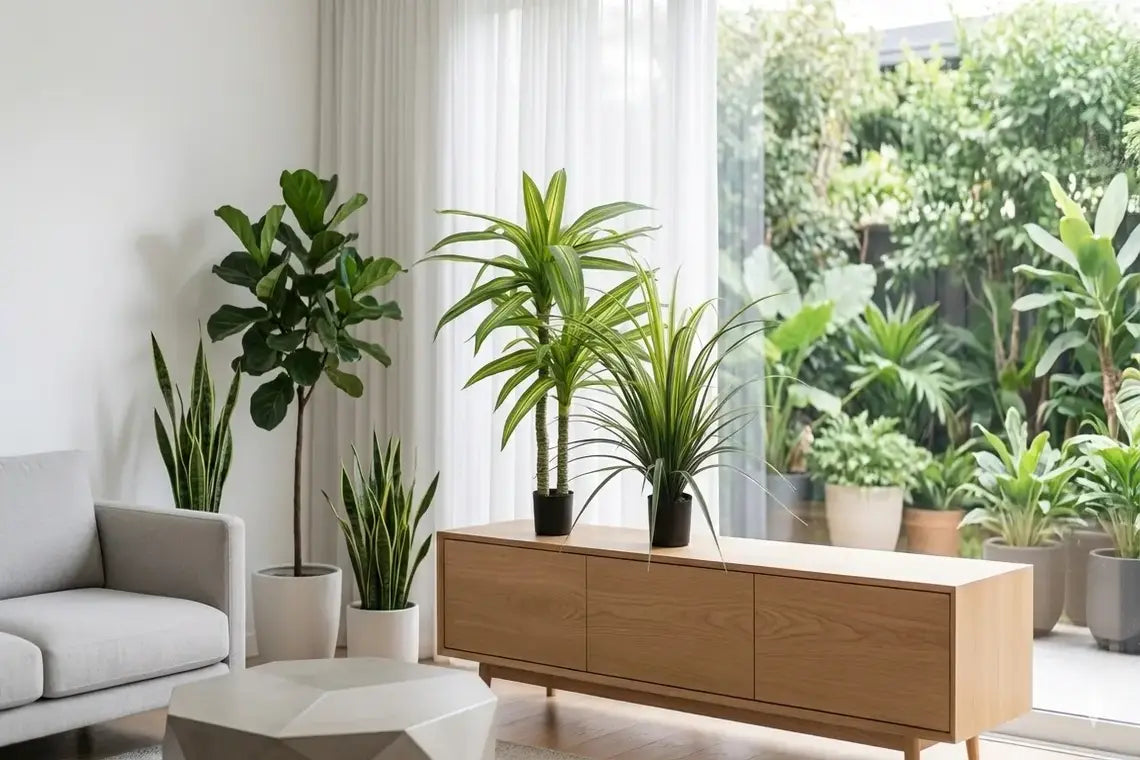
Exactly. How do you do it? How can you have a sure shot way to separate the magnificent from the mediocre when browsing for greenery online? It’s a digital jungle out there, and every tab you open shows another lush paradise promising to bring nature indoors. Yet, we all know the story. What looks like a botanical masterpiece on screen can arrive looking like a sad, plastic relic from a forgotten film set.
The disappointment is real. But if the secret isn’t about luck, but about literacy, you can learn to read the digital tells, the subtle clues that scream high-end replication versus cheap imitation. Forget guesswork. You can curate a breathtaking indoor garden from your screen, but only if you know the code. This is about decoding the pixels to find perfection.
The trap many fall into is thinking all artificial plants online are the same. There’s a vast difference between a quickly moulded piece of plastic and a botanically accurate sculpture designed to fool the most discerning eye. Buying the wrong kind is a financial misstep that drags down the feel of your entire home. Let’s change that. It’s time to stop gambling and start making informed, expert choices that fill your space with evergreen beauty that lasts.
Spot the Photographic Tricks That Hide Low-Grade Artificial Plants Online Fakes
Have you ever noticed how some product photos seem deliberately vague? They use soft focus, dramatic shadows, or keep the camera at a respectable distance. This is camouflage. Low-quality manufacturers of fake plants are masters of hiding their product's flaws. They don’t want you to zoom in on the clumsy glue marks, the uniform plastic sheen, or the paper-thin leaves that are all identical.
A premium botanical, however, invites inspection. It stays open to a close-up. When you’re browsing, actively hunt for high-resolution images that let you get right up to the foliage. What you are looking for is imperfections. Real leaves have veins, subtle colour shifts, and varied textures. If every leaf on that faux ficus is a carbon copy of the next, it’s a red flag. A plant like the Grand Artificial Potted Travellers Palm (Banana Palm Tree) 120cm should show you the detailed ribbing on its leaves and the organic way they connect to the stem.
 The quality is in those minutes, true-to-life details that a camera can’t easily fake.
The Materials Litmus Test for Fake Plants UV-Resistance Is Non-Negotiable
Here’s a costly mistake many Australians make: they forget about the sun. Sunlight sneaks in, even indoors. Through windows, across shelves, straight onto plastic. Without protection, it shows. Colours fade. Leaves stiffen. That rich green you liked slowly slips into a dull blue grey, sitting there and reminding you why the choice mattered. When buying artificial plants online, UV resistance is the difference between something that lasts and something that quietly gives up.
How do you spot it?
- Don’t Skim: Read the description properly. It should clearly be said that UV-resistant, UV-proof, or UV-treated. If it avoids saying that outright, the answer is usually no.
- Consider the Construction:For pieces like the Slimline Flowering White Artificial Green Wall Disc UV Resistant 100cm (Black Frame), the details are critical.
 Leaves aren’t the whole story. The frame matters just as much. When something calls out a weatherproof black frame, it’s signalling real build quality, made to sit outside and take a beating, which means a sunroom won’t faze it. Cheap wood and thin plastic don’t stand a chance. They twist, crack, and drag the entire piece down with them.
Skipping UV protection is a rookie mistake. Like buying a car with no roof in a city where it rains nonstop. The product might look fine at first, but it’s never going to do the job it was meant to do.
Why Perfect Symmetry in Artificial Plants and Flowers Is the Enemy of Realism
Nature does not do straight lines or perfect repetition. Think about a real orchid. Its stem has a gentle, organic curve, and each bloom is subtly different. Now, think about cheap artificial plants and flowers. They often come from a single mould, resulting in robotic symmetry. Every petal is the same. Every leaf point in the same direction. This uniformity triggers our subconscious "that’s a fake" alarm.
To find quality, you must seek out products that celebrate natural variation. Look for terms like "hand assembled." This indicates a human aspect, an artist who has arranged the foliage to mimic a living plant’s organic chaos. A piece like the 46cm Butterfly Artificial Orchid White should avoid that cookie-cutter look.
 A high-quality replica will have delicate, almost translucent petals and even show some faux roots at the base, just as a real one would. When you see this level of detail in artificial plants and flowers, you know the manufacturer has studied the real plant, not just a picture of it. The goal is to make your guests have to inspect it to be sure.
The Critical Mistake of Misjudging Scale and Volume
Product photos are notoriously deceptive when it comes to size. A small plant can be made to look enormous with clever staging. This is why your tape measure is your most important tool when shopping for greenery online. Don’t just guess what 160cm looks like; measure it against your wall.
However, height is just part of what matters. Consider these factors as well:
- The density of the foliage:Is the plant lush and full, or can you see straight through it to the central plastic pole? A sparse plant looks cheap and unconvincing. Look for wording like "dense foliage" in descriptions. The Artificial Dense Hanging Evergreen Plant (two-tone) UV Resistant 130cm uses that exact term, promising a full, cascading look.
-
 The adjustability of the stems:Premium artificial plants have wire integrated into their leaves and branches. This allows you to "fluff" and shape the plant after unboxing. You can bend the fronts of a palm like the Premium Artificial Areca Palm Tree Real Touch 160cm to create a wider, more natural canopy.
 If a plant is rigid and cannot be manipulated, it will always look stiff and unnatural in your space.
Your Plant's Pot Is Telling You a Secret
The quickest way to spot a cheap artificial plant is often by looking at its base. Low-end fake plants are frequently plopped into a tiny, flimsy plastic pot filled with something that looks like painted concrete. They’re unstable and visually jarring. The pot is an afterthought, and it shows.
A quality manufacturer recognises that the foundation matters for the whole illusion. For larger floor plants, a weighted base is needed for stability. You do not want your beautiful new palm tree tipping over every time someone walks past it. For smaller decorative plants like the Artificial Lily Plant, the pot’s proportions and weight remain important.
The specifications should show you the pot’s dimensions and the plant's approximate weight, letting you plan where it will sit and what decorative planter it might fit into. Most high-quality botanicals come in a simple, weighted starter pot, made to be placed inside a more stylish outer planter of your choice. This is the industry standard for excellence.
Beyond Star Ratings: How to Actually Read Customer Reviews
| What The Review Says | What It Is Really Revealing | How to Read It Properly |
| “Everyone thought it was real until I told them” | Visual credibility that survives close viewing | Indicates believable form colour and finish under normal lighting |
| “Looks exactly like the photos online” | Honest product photography and material accuracy | Suggests no colour correction tricks or misleading angles |
| “Leaves feel solid and don’t bend weirdly” | Structural integrity and decent internal wiring | Confirms the plant can be shaped without damage |
| “Arrived packed well and fluffed easily” | Thoughtful construction and handling tolerance | Shows the plant survives transit without deforming |
| “Didn’t expect it to look this good” | Expectations were exceeded rather than managed | Signals value beyond surface appearance |
| “Looks fine but feels plasticky” | Surface finish gives away artificial origin | Points to cheap polymers and poor light behaviour |
The True Cost of Cheap: The Fallacy of a Bargain
| What You Save Today | What Quietly Happens Later | What You End Up Paying For |
| Lower upfront price | Colour dulls and surfaces stiffen | Visual downgrade across the entire space |
| Lightweight construction | Plant tips shifts or collapses | Replacement or constant repositioning |
| Basic plastic materials | Dust clings and never releases | Time frustration and eventual disposal |
| No UV protection | Fading near windows begins early | Shortened lifespan even indoors |
| Minimal assembly effort | Leaves snap during shaping | Loss of form and credibility |
| Quick aesthetic hit | Space starts feeling temporary | Another purchase sooner than planned |
What "Real Touch" Actually Means for You
The term "Real Touch" appears often, but what does it signify? It refers to a specific manufacturing process and material, typically a high-grade polyurethane or latex. This material achieves two things that standard plastic or silk fails to deliver.
First, it copies the cool, slightly waxy feel of a living leaf. This tactile realism is what creates that moment of doubt, even for you.
Second, and perhaps more importantly, it affects how the leaf reacts with light. Cheap plastic shows a high gloss finish. It reflects light like a mirror, creating an unnatural glare that immediately gives away a fake. "Real Touch" materials have a more matte finish. They absorb some light and reflect the rest softly, similar to a real leaf. This difference in how it interacts with light is what helps sell the illusion. A product like the Real Touch Artificial Palm Tree 160cm High uses this technology to create a level of realism that basic plastic cannot produce.
Final Word
Most spaces don’t fall flat because of big mistakes. They fall flat because of tiny ones. Missed details. Cheap finishes. Greens that feel off the moment you stop and look. Choosing artificial plants online the right way shifts that. What should be a throwaway buy turns into something that actually holds its ground in your space.
This is about building a setting that feels settled, not staged. Greenery that stays put, looks right, and doesn’t ask anything from you in return. No watering. No replacing. No quiet disappointment when it starts to look tired. Your home deserves better than shiny plastic pretending to be alive.
If you’re done guessing and want botanicals that pass the second-glance test, we’re here. For a collection where every item is checked for realism, durability, and sheer beauty, visit us at Designer Plants. It is time to bring home greenery that truly lasts.