
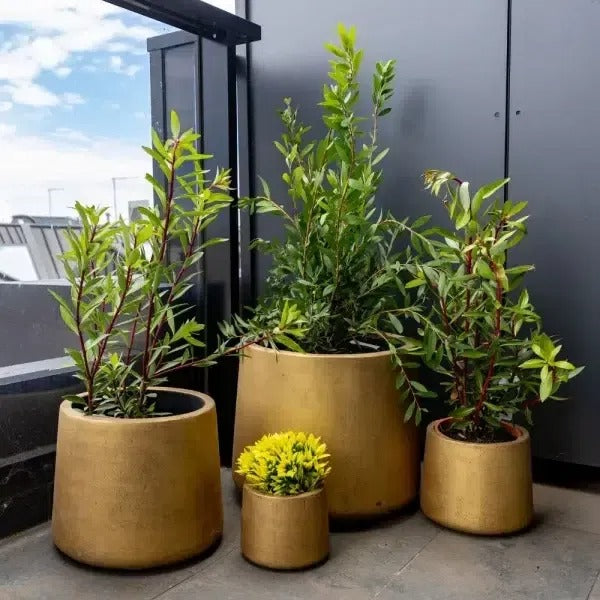
Fake plants don’t need water but they do need respect. It starts with the right pot and ends with everything most people get entirely wrong.
Yes, there’s an art to potting artificial plants. And no, it’s not the same as dropping them into a container and hoping for the best. The right planter is more than a container. It’s what anchors the illusion, completes the visual and lets the plant carry weight in a space. Potting fake potted plants the wrong way? You don’t just end up with something that looks off. You end up with an awkward centrepiece that calls itself out before anyone else gets the chance.
Here’s everything you didn’t know you needed to know. And everything most people still don’t. About how to pot artificial plants using planters. And why skipping these steps will cost you a lot more than just aesthetics.
Stop Dropping and Hiding Your Fake Plants in Oversized Pots
If your artificial plant looks like it’s drowning in a cavernous planter or tipping sideways in a pot too small to hold it steady, that’s not a design style. That’s a visual misstep that steals attention in the worst way.
The goal of potting fake plants is to make them look convincingly real. And that means the planter has to look like it was meant for it. Proportioned, grounded and intentional.
Here’s what gets overlooked far too often:
- Weight distribution matters. Use dry river stones or pebbles at the base to stabilise top-heavy stems.
- Use expanding foam to lock artificial stems in place before adding top layers such as preserved moss or bark.
- Avoid translucent planters unless you plan to conceal the inner mechanics cleverly. Exposed wires or concrete lumps are dead giveaways.
This is where the Modern White Concrete Terrazzo Planters from our range pull serious weight.

With their clean, matte finish and round minimalist silhouette, they ground your artificial potted plants without competing with them. Plus, you get four different sizes in the set, so you're never forcing a one-size-fits-none situation.
Understand Why the Right Planter Changes Everything
Most people think the plant does the talking. It doesn’t. The planter holds the story.
Think about it. Have you ever seen a real plant stuck in a metal bucket with no base support or a bushy ficus standing straight up in a lightweight tin? No. Realism isn’t just about the leaves or the stems. It’s in the potting.
That’s exactly why the Imitation Dark Stone Geometric Planter exists.
This square, earthy-toned masterpiece adds believable weight and structure. The materials are recycled and built to last, but the look screams architectural stability. For artificial potted plants that are designed to be squarely grounded, this one wins every time.
Learn the Hidden Mechanics of Potting Artificial Plants
No one talks about this, but here’s a behind-the-scenes look at how professional stylists and set designers pot artificial plants to fool even the trained eye.
- Insert a builder’s foam base into the pot and carve it to snugly fit the base of your fake plant. This forms your anchor.
- Secure the plant with glue or skewers pushed into the foam. Don’t let it wobble or look loose.
- Cover with realistic topping. Moss, soil, coconut husk or crushed bark. This hides the synthetic structure and adds authenticity.
- Add balance and bulk with weighty stones or sand in the base. This prevents accidental tipping, especially in outdoor areas.
We’ve seen clients in coastal areas of New South Wales use our Hanging Rustic White Plastic Pot with Chain not just for style but for pure functionality.
 Lightweight yet durable, it’s become a firm favourite for people hanging artificial vines on balconies and small patios. With the right styling, most guests don’t even realise the greenery isn’t real. And they often ask where to water it.
Forget Seasonal Plants and Start Season-Proofing With Artificial Ones
One of the smartest ways to use artificial plants is by potting them seasonally. Sounds ironic? Let us explain.
You can swap out your artificial plant arrangements with the seasons without having to repot everything. The plant itself is the interchangeable part. Your planter stays.
Our Premium Floating Half Moon Wall Planter is the perfect partner for this.
This onyx black stunner can hang indoors or outdoors, and its shape lets you showcase hanging vines in summer or rich foliage in winter. All fake, all season-proof and all reusable. And the best part? Swapping out artificial plants is mess-free. No dirt. No pests. No guilt.

This trick is how interior designers in urban pockets of Victoria are staying on-trend without constantly updating furniture. A few good faux plants, seasonally rotated, and no one questions the freshness of your style.
Make Your Fake Plants Work in Tiny, Awkward or Dead Spaces
Some corners just don’t support real plants. Too little sunlight. Too much traffic. Too many knocks from vacuum cleaners. These are the spaces begging for cleverly potted fake potted plants.
That’s why we created our Imitation Stone Pot in Cream.
20cm across, subtle and compact enough to fit in places where you wouldn’t dare keep real greenery. Bathroom corners. Bookshelves. Benchtops. Even laundry rooms.
Potting artificial plants into smaller planters is also a great way to bring calm and greenery into places such as rental apartments where permanent fixtures aren’t allowed.
Here’s how you can make it work:
- Use indoor-safe adhesives or mounting putty to fix the planter base on a shelf
- Add preserved moss or artificial soil top cover for realism
- Place the pot alongside real textures such as timber, linen or concrete for contrast

Don’t Just Think Ground Planters Think Verticals and Walls
The fastest way to kill the illusion of artificial plants is to pot them only on the floor. Real greenery doesn’t grow in flat layers. It creeps, spills, hangs and towers. That’s why wall planters, hanging pots and staggered arrangements aren’t just style choices. They’re realism tactics.
We’ve seen clients use the Grey Metal Planter as a sleek linear base for hedge panels to create artificial garden screens in office foyers or balconies. It adds visual structure and gives the illusion of a well-trimmed hedge garden without watering or trimming a thing.
Artificial hanging vines in floating wall planters such as our Half Moon Onyx Black Planter create vertical interest. They draw the eye up, give the space dimension and distract from the fact that they’re not real.
Use these planter types like a set designer would:
- Hang planters in clusters to create wall stories
- Use small square planters to bookend shelves or credenzas
- Place neutral-toned pots in entryways to create soft transitions
Why Weight, Texture and Scale Matter More Than You Think
Potting artificial plants isn't just about stability. It's about believability. That means getting the scale of the pot, the weight of the material and the texture absolutely right.
Here's what makes or breaks the illusion:
- Scale: A small shrub in a giant pot looks cartoonish. A tall palm in a skinny vase looks like it's starving. Match the plant and pot size like you'd match a picture frame to the art.
- Weight: Fake plants are top-heavy and need grounding. A heavy planter keeps them safe from tipping in windy or high-traffic areas.
- Texture: Use pots that don't shout 'plastic'. Think brushed concrete, powder-coated metal or textured finishes. These visual cues sell the realism.
And if you want all three. Scale, weight and texture. Together, the Imitation Dark Stone Square Planter does exactly that. It carries the kind of heft and edge that makes even a $30 fake tree look like a nursery-bought statement piece.
How to Avoid Rookie Mistakes That Sabotage the Look
There’s nothing worse than spending money on fake plants and then giving away the game with a poor potting job.
Here are the most common mistakes we see. And how to fix them:
- Using bright, glossy filler pebbles. Opt for muted, natural colours.
- Letting the fake trunk lean. Reinforce the base with wire or dowels if needed.
- Exposing foam or plastic. Always finish with top dressing that looks like soil or mulch.
- Forgetting proportion. Don’t hide a short plant in a tall pot or cram a wide tree into a tiny vase.
These might sound minor, but the impact they have on the realism is massive. If you’ve ever walked into a space and felt like something was ‘off’ without being able to point it out. Chances are, one of these mistakes was the culprit.
Final Word
Fake plants have come a long way from the dusty plastic ferns of the past. But potting them poorly puts all that progress in reverse. If you're using artificial plants, how you pot them can either sell the illusion or wreck it instantly.
We’ve spent years at Designer Plants crafting planters that aren't just containers. They’re part of the story. From compact pots to floating wall designs, everything we create is built to complement your artificial potted plants and give them the stature they deserve.
If you're ready to stop hiding the base of your fake plants behind excuses and start showing them off like the design pieces they are, we're here to help. Because the right planter doesn’t just hold your plant. It holds the entire look together. And at Designer Plants, we’re all about making that look impossible to ignore.